What Is MCP (Model Context Protocol)? How AI Agents Connect to Your Business Tools
You’ve probably seen AI demos where an assistant books a meeting, pulls a CRM record, updates a spreadsheet, and sends a Slack message — all in one go. And you’ve probably wondered: how is it actually talking to all those tools?
The answer, in most modern AI stacks in 2026, is MCP.
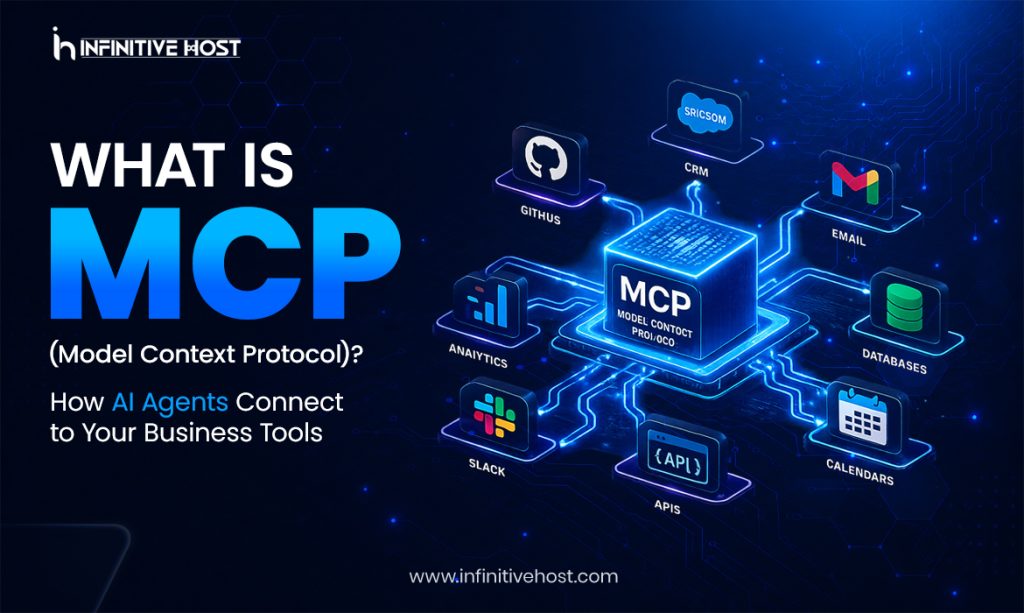
Model Context Protocol is the standard that lets AI agents connect to external tools, databases, and business systems in a structured, reliable way. Think of it less like a feature and more like a handshake protocol — the agreed language that lets your AI agent ask your CRM a question and actually get a useful answer back.
Before MCP existed, every integration was custom. You built a connector for Salesforce, another for Google Drive, another for your internal database. Each one was brittle, each one broke differently, and maintaining them was someone’s full-time job. MCP standardises that entire layer.
What MCP Actually Does — In Plain Terms
Here’s the cleanest way to think about it.
An AI agent is smart but blind. It knows how to reason, generate, and respond — but it has no native access to your business data. It can’t see your customer records, your inventory system, your support tickets, or your calendar. Without a connection layer, it’s a very capable system operating in complete isolation.
MCP is that connection layer. It defines how an AI agent requests information from an external tool, how that tool responds, and how the agent incorporates that response into its next action. It handles authentication, data formatting, error states, and context passing — all the plumbing that makes agent-to-tool communication reliable rather than fragile.
The result: an AI agent built on MCP can query your database, trigger a workflow, read a document, update a record, and hand off to another system — all through a single standardised protocol rather than a pile of custom integrations.
Why This Matters for Real Businesses
Most businesses don’t need a custom AI model. They need their existing tools to be smarter — faster to query, better at surfacing the right information, capable of acting on instructions without someone manually clicking through five screens.
MCP makes that possible without rebuilding your entire tech stack.
A customer support team using an MCP-connected AI agent can have it pull the customer’s order history from one system, check the return policy from a knowledge base, draft a response, and log the interaction — all triggered by a single support ticket. No switching tabs, no manual lookups, no copy-pasting between systems.
This is implementing MCP for your business in its most practical form: not replacing your tools, but connecting them through an AI layer that can act across all of them simultaneously.
The same pattern applies to sales teams querying CRM data, finance teams pulling reports, HR teams screening documents, and operations teams monitoring live dashboards. MCP is tool-agnostic — it connects to what you already use.
MCP + RAG: The Combination That Actually Works
MCP handles tool connectivity. RAG (Retrieval-Augmented Generation) handles knowledge retrieval. Together, they’re the foundation of a genuinely useful business AI agent.
Here’s how they work together: an MCP-based agent with a self-hosted RAG pipeline can receive a question, retrieve relevant context from your internal knowledge base via RAG, pull live data from a connected business tool via MCP, and generate a response that combines both sources — institutional knowledge plus real-time data, in a single answer.
The self-hosted part matters more than most vendors admit. Hosting your RAG pipeline internally means your business documents, customer data, and proprietary information never leave your infrastructure. For any business handling sensitive client data — legal, financial, healthcare, enterprise SaaS — self-hosted RAG paired with MCP is the architecture that passes a security review, not just a demo.
How Infinitive Host Supports MCP Deployment
This is where infrastructure meets implementation. An MCP agent architecture requires reliable hosting, sufficient compute for inference, vector database capacity for RAG, and the network performance to make real-time tool queries feel instantaneous rather than sluggish.
Infinitive Host — through its AI Software Services — provides the infrastructure layer for businesses implementing MCP-based agents without building a data centre from scratch. Connecting your business I tools with Infinitive Host’s AI Software Services means your MCP agent stack runs on dedicated infrastructure rather than shared cloud resources that introduce latency at exactly the wrong moments — during live customer interactions, real-time data queries, and time-sensitive workflow triggers.
For teams that want the full stack in one place, Infinitive Host AI chatbot hosting covers the deployment, maintenance, and scaling of MCP-connected agents — so your team focuses on what the agent does, not on keeping the server running. This matters particularly for businesses that want to move from prototype to production without hiring a dedicated DevOps engineer to manage the infrastructure in between.
The combination of MCP protocol, self-hosted RAG, and Infinitive Host’s dedicated AI infrastructure is currently the cleanest path from “we want an AI agent” to “we have one in production that actually works.”
Conclusion
MCP isn’t a buzzword. It’s the protocol that makes AI agents actually useful in a business context — connecting reasoning capability to real data, real tools, and real workflows. Without it, AI agents are impressive in demos and limited in practice. With it, they become a genuine operational layer across your existing tech stack.
The businesses moving fastest in 2026 are the ones that stopped waiting for a perfect AI product and started connecting their existing tools through MCP. Whether that’s a customer support agent, a sales assistant, or an internal knowledge tool, the architecture is the same: MCP for tool connectivity, RAG for knowledge retrieval, and reliable infrastructure — like Infinitive Host’s AI software services — underneath it all.
If you’re evaluating implementing MCP for your business, the starting point isn’t the AI model. It’s the connection layer. Get that right and everything else follows.