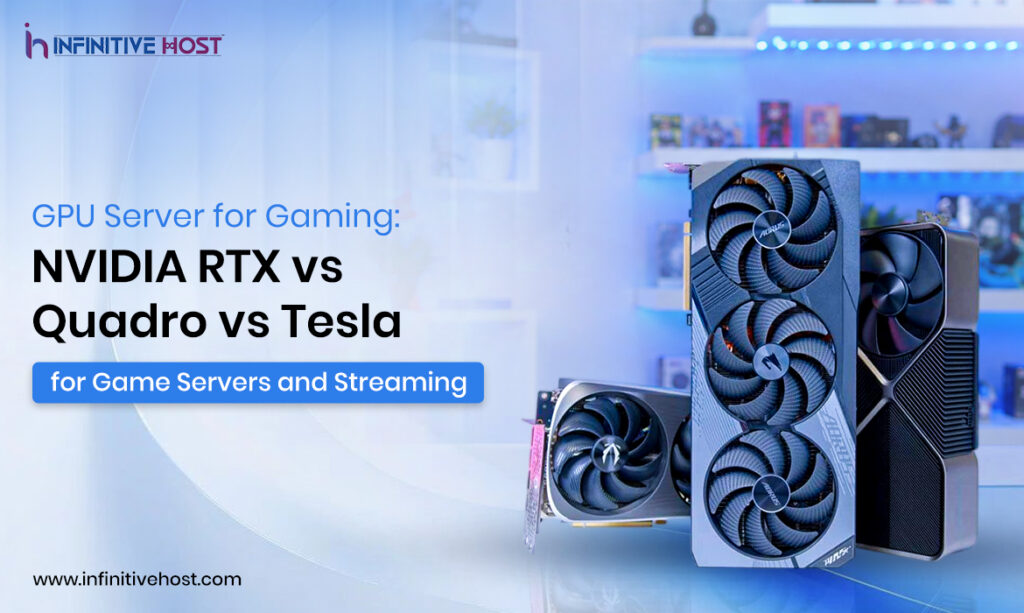
Choosing the right GPU server for gaming is one of those decisions that quietly makes or breaks a project. Get it wrong, and you’re either overpaying for horsepower you don’t need or watching your players rage-quit over lag. Get it right, and your game servers just… work. This guide breaks down the three big NVIDIA families — RTX, Quadro, and Tesla — so you can pick the right GPU server for gaming without the guesswork.
Why the GPU Choice Actually Matters
A GPU server for gaming isn’t just about raw teraflops. It’s about the right mix of rendering power, encoding efficiency, driver support, and cost. Studios running multiplayer titles, cloud gaming platforms, and streaming services all lean on different hardware because their workloads aren’t the same. Rendering a live match for thousands of viewers is a different job than hosting a dedicated Minecraft server.
NVIDIA RTX: The Gamer’s Choice
RTX cards are built for real-time rendering, ray tracing, and — critically — NVENC hardware encoding, which is the backbone of modern game streaming. When people search for a GPU server for gaming meant for Twitch-style broadcast or cloud game streaming, RTX is usually the answer.
Strengths of RTX-based GPU server for gaming setups:
- Excellent price-to-performance ratio
- Native support for ray tracing and DLSS
- Strong NVENC encoders for low-latency streaming
- Widely supported across game engines (Unreal, Unity, Source)
RTX is the go-to pick for a UK GPU dedicated RTX server cloud game streaming setup, and it’s equally popular for a France GPU server RTX game server French market deployment where studios want gamer-grade visuals without enterprise pricing.
Another reason RTX keeps winning as the default GPU server for gaming option is community support. Because millions of gamers already run RTX cards at home, developers optimize their engines and anti-cheat systems around this architecture first. That means fewer driver conflicts, faster patches, and a smoother experience for anyone renting a server rather than building one from scratch.
NVIDIA Quadro: Built for Precision, Not Play
Quadro (now branded RTX A-series in workstation form) was designed for CAD, 3D modeling, and professional visualization — not gaming. It offers certified drivers and ECC memory, which matters for stability in long-running enterprise workloads, but it’s overkill and often underwhelming for actual gameplay rendering.
That said, some hosts still deploy Quadro for hybrid workloads — rendering plus light gaming tasks — particularly in enterprise environments. A Germany GPU server Quadro vs Tesla EU game servers comparison usually shows Quadro losing out to RTX on frame rates but winning on driver certification and multi-application stability.
NVIDIA Tesla: Data Center Muscle
Tesla (now the “Data Center GPU” line) is built for AI training, inference, and virtualization at scale — not native gaming performance. It lacks display outputs and dedicated ray-tracing cores in older models. However, Tesla GPUs shine in virtualized environments where a GPU server for gaming needs to be sliced across dozens of concurrent sessions using vGPU technology, like large cloud gaming platforms.
The trade-off is straightforward: Tesla cards trade per-session gaming performance for sheer scale. A single Tesla-powered node can serve many lightweight gaming sessions at once, which is exactly why cloud providers building region-wide infrastructure often lean on this family rather than stacking dozens of individual RTX cards.
RTX vs Quadro vs Tesla: Quick Comparison Table
| Feature | RTX | Quadro | Tesla |
| Best for | Gaming, streaming | Professional rendering | AI, virtualization, cloud scale |
| Ray tracing | Excellent | Good | Limited/None (older models) |
| NVENC streaming | Excellent | Moderate | Weak |
| Driver certification | Consumer-grade | ISV certified | Enterprise-grade |
| Cost efficiency | High | Medium | Low (for pure gaming) |
| vGPU multi-session support | Limited | Moderate | Excellent |
Regional Considerations for a GPU Server for Gaming
Latency and data residency shape which region you should pick for a GPU server for gaming deployment:
- Sweden GPU dedicated server Nordic gaming nodes — ideal for low-latency Nordic and Baltic player bases
- Switzerland GPU server for esports server hosting — favored for esports tournaments needing neutral, stable infrastructure
- Ireland GPU server EU West low-latency game hosting — a strong pick for western European multiplayer titles
- Netherlands GPU server EU multiplayer game nodes — a classic hub for EU-wide multiplayer routing
- India GPU cloud Asia Pacific game server hosting — increasingly popular for reaching the fast-growing APAC gaming market
- USA GPU dedicated server RTX vs Tesla game benchmarks — where most head-to-head RTX vs Tesla performance testing happens
Streaming Workloads Need a Different Lens
If your priority is cloud streaming rather than raw hosting, the calculus shifts again. A GPU4Host RTX vs Quadro vs Tesla game server test typically confirms what most operators already suspect: RTX wins on encode quality and cost, Tesla wins on scale, and Quadro sits in a professional middle ground that rarely justifies its price for pure gaming.
Where InfinitiveHost Fits In
For teams that don’t want to manage the RTX vs Quadro vs Tesla decision alone, Infinitive Host offers pre-configured GPU server for gaming plans tuned for both hosting and streaming use cases. Their InfinitiveHost RTX game GPU hosting — save 25% OFF offer is currently one of the more competitive entry points for studios testing RTX-based deployments before committing to long-term contracts.
Making the Final Call
Here’s a simplified way to think about it:
- Choose RTX if you’re hosting a dedicated multiplayer server or streaming gameplay to viewers
- Choose Quadro if your workload mixes 3D rendering with occasional gaming tasks
- Choose Tesla if you’re building a cloud gaming platform that needs to virtualize GPU power across many users
Conclusion
There’s no single “best” GPU — only the best fit for your workload. For most studios and streamers, an RTX-based GPU server for gaming delivers the best balance of cost, encoding quality, and raw performance. Quadro remains a niche choice for professional rendering crossover work, while Tesla dominates large-scale, virtualized cloud gaming deployments. Whether you’re deploying in Germany, the UK, France, Sweden, Switzerland, Ireland, India, the Netherlands, or the USA, matching your GPU family to your actual workload — not just the biggest spec sheet — is what separates a smooth game server from a laggy one.