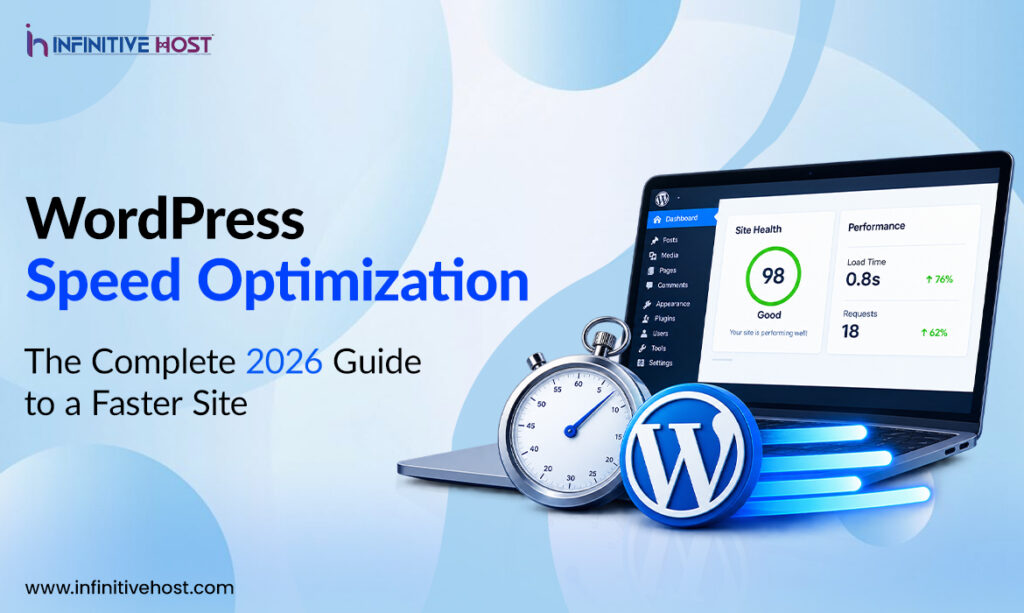
Somewhere around the third second of a slow page load, most visitors are already gone. That’s just how people browse in 2026. If your site drags, they bounce, and Google notices too. That’s why WordPress speed optimization isn’t an optional tweak anymore — it’s the difference between a site that converts and one that quietly bleeds visitors every day.
This guide covers what actually moves the needle for WordPress speed optimization this year — not recycled “compress your images” advice, but hosting choices, caching strategy, image handling, code bloat, and where a provider like Infinitive Host fits in.
Why WordPress Speed Optimization Matters More in 2026
Google’s Core Web Vitals have only gotten stricter, and users have gotten less patient. A slow WordPress site doesn’t just annoy visitors — it tanks conversions, hurts SEO rankings, and increases bounce rates across the board. WordPress speed optimization touches nearly everything: how long it takes your homepage to render, how smooth scrolling feels, and how quickly buttons actually respond when someone taps them.
What is annoying about WordPress is that, as a default configuration, it isn’t designed to be fast. It is flexible, with numerous add-ons and themes. This flexibility makes it slow if not controlled. Real WordPress speed optimization means finding the balance between keeping the flexibility you need and stripping out everything slowing you down.
Start With Hosting, Not Plugins
Here’s something people get backwards constantly: they install five speed plugins before ever questioning their hosting. But no plugin can fix a server that’s fundamentally too slow or overcrowded. This is the part of WordPress speed optimization most tutorials skip, and it’s the one that matters most.
Shared hosting crams hundreds of sites onto a single server, all competing for the same limited resources. The moment traffic picks up on a neighboring site, yours can slow down too, with nothing you can do about it. This is where managed WordPress hosting built for speed changes the equation.
Managed WordPress hosting built for speed typically includes server-level caching, optimized database configurations, and infrastructure tuned specifically for how WordPress runs — not a generic setup meant for any kind of site. Infinitive Host has built its managed WordPress offering around exactly this idea.
If you’re serious about WordPress speed optimization, the fastest WordPress Infinitive Host plans exist specifically to remove that hosting bottleneck before you even touch a plugin.
Caching: Still the Backbone of Speed
Caching remains one of the highest-impact levers in WordPress speed optimization. Every time a page loads dynamically, your server has to run PHP scripts and query the database from scratch. Caching usually stores a static version of that particular page so future site visitors get served immediately, without repeating all that work.
There are a few layers that are worth setting up:
- Page caching: stores all rendered pages for quicker repeat loads
- Browser caching: tells site visitors’ browsers to store resources locally so repeat visits load quickly
- Object caching: speeds up database queries, generally helpful on content-heavy websites
- CDN caching: allocates cached content globally so all visitors load from a server near them
A well-managed WordPress hosting service that is purposely designed to be fast can do all of this automatically at the server level, and thus take care of a huge part of your speed optimization task.
Image Optimization Hasn’t Gone Away
Images are still one of the biggest contributors to page bloat, and that hasn’t changed heading into 2026. Uncompressed, oversized images can wreck an otherwise well-optimized site. Effective WordPress speed optimization means compressing images without hurting quality, using modern formats like WebP or AVIF, and lazy-loading anything below the fold.
Plugins can automate most of this, but it still needs checking periodically — new images get uploaded uncompressed more often than you’d think, quietly undoing your work over time.
Clean Up the Plugin and Theme Bloat
Every plugin adds a little weight — extra database calls, additional scripts, sometimes render-blocking CSS. It’s easy to end up with a dozen plugins overlapping in function or simply not needed anymore. A core part of ongoing WordPress speed optimization is periodically auditing what’s running and cutting what isn’t earning its place.
The same logic applies to themes. Heavy, feature-packed themes often load resources you’ll never use. A leaner theme combined with powerful WordPress speed optimization practices will almost always outperform a flashy one stuffed with unused functionality.
Database Maintenance Matters More Than People Think
Over time, WordPress databases accumulate junk — post revisions, spam comments, expired transients — all of which slow down queries. Regular database cleanup is a quieter but still meaningful piece of WordPress speed optimization, especially for sites that have been running for years without a cleanup pass.
Where Infinitive Host Fits Into the Picture
Infinitive Host has positioned itself specifically around managed WordPress hosting built for speed, handling server-side caching, database tuning, and infrastructure optimization so site owners aren’t left guessing at technical configurations. For anyone serious about WordPress speed optimization without wanting to become a server engineer in the process, the fastest WordPress Infinitive Host setup takes care of the heavy lifting that plugins alone simply can’t fix.
Measuring What Actually Works
None of this matters if you’re not measuring it. Tools like Google PageSpeed Insights, GTmetrix, and Core Web Vitals reports give concrete data on where your WordPress speed optimization efforts are paying off — and where they’re not. Test after every major change, not just once a year, since a single new plugin or unoptimized image can undo weeks of careful work.
Winding Up
Speed optimization for WordPress websites in 2026 won’t be something you can simply do once and put away. This will be a never-ending combination of quality hosting, caching, minimal number of plugins, and maintenance, which will multiply over time. You set the basis – from choosing managed WordPress hosting built for speed instead of a standard shared hosting solution – and then everything else follows.
The results of the actual speed optimization of a WordPress website are equal regardless of whether you’ll take care of the whole process by yourself or hire a company, such as Infinitive Host.