Running an OTT platform today is nothing like it was five years ago. Audiences expect buffer-free playback, instant load times, and flawless quality on every device — from a 65-inch OLED to a phone on a subway. Meeting that bar requires more than great content. It demands the right streaming server infrastructure underneath everything.
This guide tells you what a solid setup looks like in 2026 — whether you’re launching fresh, migrating off a legacy stack, or scaling a platform already hitting its ceiling.
Why Your Streaming Server Choice Actually Matters
Most platform builders spend months obsessing over content libraries and UI, then wire up the cheapest hosting they can find at the last minute. That’s the wrong order of operations.
Your streaming server is the backbone of the entire viewer experience. It handles encoding, delivery, latency management, and concurrent session loads simultaneously. Get it wrong, and no amount of great content saves your churn rate. A slow server is invisible in testing and devastating to your users at 8 PM on a Friday.
In 2026, the gap between budget hosting and dedicated streaming hosting has never been wider. General-purpose cloud servers aren’t built for the sustained demands of video. Dedicated infrastructure handles transcoding pipelines, ABR delivery, and origin-edge routing in ways that commodity VPS instances simply cannot.
OTT Live Streaming and VOD: Two Different Infrastructure Problems

Here’s something a lot of guides gloss over: OTT Live Streaming and VOD are fundamentally different workloads and must be treated as such.
Live streaming is relentless. Segments get packaged and pushed continuously, and any delay compounds in real time — viewers notice a five-second drift instantly. You need low-latency ingest via RTMP or SRT, fast segment packaging, and an edge network that fans out to thousands of concurrent viewers without choking.
VOD is about storage efficiency, fast first-frame delivery, and smart caching. A viewer hitting play at 3 AM should get the same experience as someone watching during primetime — which demands a different approach to origin sizing, CDN configuration, and bitrate ladder design.
GPU Hosting for Live Streaming: The Game-Changer Most Platforms Are Still Sleeping On
Real-time transcoding at scale used to require enormous CPU farms. That math has changed. GPU hosting for live streaming has matured to where a single GPU-equipped server can outperform a full rack of CPU nodes for H.264/H.265 encoding — at a fraction of the power cost.
If your platform runs more than a handful of simultaneous live channels, or encodes at 4K with multiple quality tiers, GPU-based transcoding is no longer optional. Per-stream costs drop sharply, latency improves, and GPU encoders produce better visual output at the same bitrate — a sharper picture for viewers without paying more for bandwidth.
Location Matters More Than You Think
Streaming is a latency business. The physical distance between your server and your viewer directly shapes performance, especially for live events. At present, multi-region infrastructure is table stakes, not an exclusive add-on.
If your target audience is based in the UK, the best streaming server in London always puts your origin close to the Western European audience, cutting round-trip times drastically. The best streaming server in Montreal covers Canada and northeastern US efficiently. The best streaming server in Los Angeles anchors Pacific coast traffic, while the best streaming server in New York gives you Tier 1 connectivity into one of the densest viewer markets on earth.
Smart platforms pair a primary origin in their largest market with edge nodes in secondary regions — so every viewer gets fast, local-feeling delivery no matter where they are.
What a Production-Ready Setup Actually Looks Like
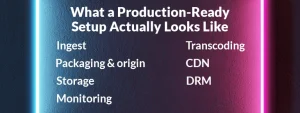
- Ingest: SRT-capable servers with redundant failover paths
- Transcoding: GPU-accelerated nodes handling H.264, H.265, and AV1 simultaneously
- Packaging & origin: Dedicated streaming origin with CMAF for low-latency HLS and DASH
- CDN: Multi-provider setup with intelligent switching on real-time performance data
- Storage: Tiered object storage — hot for recent VOD, cold for archive
- DRM: Widevine, FairPlay, and PlayReady baked into the delivery stack
- Monitoring: Real-time health dashboards with sub-10-second alerting on segment failures
This is the minimum viable stack for a platform that wants to compete in 2026. Skimp on any layer and it becomes the bottleneck that defines your worst night.
Don’t Overpay to Get Started
Infrastructure investment doesn’t have to happen all at once. Providers like Infinitive Host offer dedicated streaming hosting built specifically for OTT workloads, with clear upgrade paths and streaming-native support. Right now, you can Get 25% Off on Streaming Servers through Infinitive Host — making it one of the most cost-effective entry points for platforms that need professional-grade infrastructure without enterprise-level spend.
Starting lean on a reliable streaming server and scaling GPU capacity as your viewer count grows is far smarter than front-loading a full build before you’ve validated your audience. The key is locking in a provider who scales with you, not one who locks you into hardware you’ll outgrow or underutilize.
Final Thoughts
Selecting the best streaming server in 2026 is not a technical afterthought—it’s one of the most consequential decisions you’ll make when developing or growing an OTT platform. Ranging from GPU hosting for live streaming to region-based deployments in Los Angeles, London, Montreal, and New York, every single infrastructure decision directly transforms what the target audience experiences. The reliable hosting service providers like Infinitive Host make it quite easy to begin with dedicated streaming hosting that scales alongside your chosen platform. Get the foundation right, and everything else — content, monetization, growth — becomes a lot more achievable.
Read Related – Complete guide to streaming servers and live streaming VOD