If you’ve spent any time shopping for compute power in 2026, you already know the drill — the sales pages all look the same, everyone claims to be the fastest, and somehow every provider has a “limited time offer” that never actually expires. Cutting through the noise takes work.
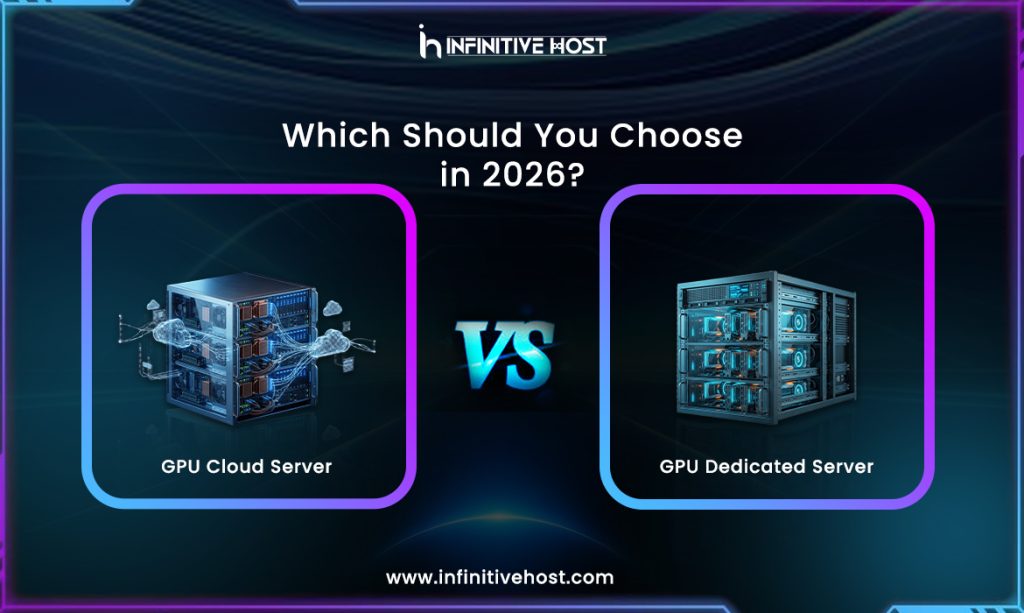
But here’s the real question teams keep landing on: GPU dedicated server vs GPU cloud server — which one actually fits what you’re building?
This isn’t a theoretical debate. Whether you’re running AI training infrastructure based in France, deploying inference workloads from managed GPU servers at Dutch Tier-3 data centers, or scaling a startup’s compute from India, the choice between dedicated and cloud GPU hosting shapes your costs, your latency, and frankly your sanity at 2 AM when something breaks.
Let’s talk through it properly.
What Is a GPU Dedicated Server, Really?

A GPU dedicated server means one thing: the hardware is yours. Nobody else shares that VRAM, those PCIe lanes, or that NVMe throughput. You get full-root GPU dedicated servers — root access, custom kernel configs, your choice of OS, driver versions locked to what your model needs.
For teams doing long-running training jobs, that isolation matters. Noisy-neighbor problems disappear. You’re not competing for memory bandwidth with someone else’s batch job at 3 AM. The performance floor and the performance ceiling are both predictable.
Enterprise GPU dedicated servers located in Sweden, for instance, are increasingly popular with European AI companies because they combine strong data sovereignty laws, reliable power (much of it renewable), and proximity to Frankfurt and Amsterdam interconnects. Similarly, high-security GPU dedicated hosting in Switzerland appeals to fintech and healthcare AI teams where compliance isn’t optional.
The flip side? You’re paying for that hardware whether it’s running at 95% utilization or sitting idle on a Sunday. And provisioning takes longer — sometimes days, not minutes.
What Is a GPU Cloud Server?

GPU-as-a-service providers for AI teams have matured a lot since 2022. Today’s GPU cloud isn’t just “rent an A100 for an hour.” You get persistent storage, VPC networking, snapshotting, and in some cases managed orchestration layers that handle job queuing, auto-scaling, and spot pricing.
The core value prop is elasticity. Spin up 16 H100s for a hyperparameter sweep, pay for the wall-clock time, spin them back down. For experimentation phases, that’s genuinely hard to beat.
DPDP-compliant GPU cloud servers in Indian data centers have emerged as a serious option for domestic AI companies after India’s Digital Personal Data Protection Act came into force. Providers hosting inside India can now credibly serve regulated industries that couldn’t previously move workloads to foreign infrastr ucture.
The tradeoff on cloud: cost per GPU-hour is always higher than the amortized cost of owned hardware at sustained load. And multi-tenant environments — even with strong isolation — introduce variables that dedicated doesn’t.
The Real Cost Math in 2026
Nobody loves spreadsheets, but this comparison demands one.
A GPU dedicated server running an 8x H100 SXM5 node typically runs between $12,000 and $18,000/month depending on location, bandwidth commitment, and support tier. Amortize that across 730 hours in a month and you’re looking at roughly $16–$25/GPU-hour at full utilization.
The same H100 on a major GPU cloud provider runs $3.50–$5.50/GPU-hour at on-demand rates — but drops to $2.00–$3.00/GPU-hour on reserved instances with 1-year commits.
The crossover point is around 55–65% sustained utilization. Below that, cloud wins. Above it, dedicated wins — often by a wide margin.
Unmetered bandwidth GPU servers in America change this math further. If your workload moves large datasets frequently — think distributed training across nodes, or inference serving with large context windows — bandwidth costs on metered cloud instances can quietly become a significant line item. Unmetered dedicated hosting eliminates that variable entirely.
Read More – GPU Server Benchmarks 2026
Where Location Actually Matters
Geography isn’t just about latency anymore.
- Full-root GPU dedicated servers in England are popular with AI teams that need GDPR compliance, UK data residency post-Brexit, and proximity to London’s financial and biotech AI ecosystems. Dedicated hardware here means you control exactly where your data lives — no ambiguity about cloud provider regional routing.
- Privately operated GPU servers in the Republic of Ireland serve a dual purpose: Ireland’s corporate tax environment draws US tech companies, and its EU membership means GDPR compliance without UK-exit complications. Several hyperscaler data centers in Dublin have made co-located privately hosted GPU infrastructure easier to source here.
- Privately hosted GPU infrastructure at German Tier-3 facilities is the choice for Mittelstand companies and German AI startups who take Datenschutz (data protection) seriously — which is most of them. German Tier-3 uptime SLAs and physical security standards are among the strictest in Europe.
Managed vs. Unmanaged: The Hidden Variable
One thing that gets glossed over in GPU dedicated server vs GPU cloud server comparisons is the management layer.
Raw dedicated hardware with no support is cheap until something breaks. Driver conflicts, CUDA version mismatches, NVLink topology bugs — these eat engineering time that most AI teams can’t spare.
Managed GPU servers at Dutch Tier-3 data centers — with 24/7 NOC support, proactive monitoring, and OS-level management included — effectively close part of the gap between dedicated and cloud. You keep the performance and isolation of dedicated hardware, but offload the operational burden. Providers like Infinitive Host have built their GPU hosting product around exactly this middle ground: enterprise-grade hardware with managed support layers that don’t require you to hire a sysadmin who speaks CUDA.
Security and Compliance in 2026
Two years ago, “secure GPU hosting” mostly meant physical access controls and DDoS mitigation. Today it means a lot more.
High-security GPU dedicated hosting in Switzerland has become a genuine product category — not just marketing language. Swiss providers can offer hardware security modules, air-gapped management networks, third-party penetration testing reports, and contractual guarantees around law enforcement access that cloud providers operating under US CLOUD Act jurisdiction simply can’t match.
For AI companies handling sensitive training data — medical records, legal documents, financial transaction histories — the compliance architecture around your compute matters as much as the compute itself.
So Which Should You Choose?
Here’s the honest breakdown:
Choose a GPU dedicated server if:
- Your GPU utilization is consistently above 60%
- You need full-root access and custom software stacks
- Data sovereignty, compliance, or security requirements are strict
- You’re running long training jobs (weeks, not hours)
- Bandwidth costs on cloud are eating your budget
Choose a GPU cloud server if:
- Your workload is experimental or bursty
- You need to scale from zero quickly
- You want to defer capital commitment while validating a product
- Multi-region deployment flexibility matters more than raw cost efficiency
Many mature AI teams end up running both: cloud for experimentation and burst capacity, dedicated for production training and inference serving. That hybrid approach often gives the best of both worlds — and increasingly, providers are building interconnects between their dedicated and cloud offerings to make that transition seamless.
Infinitive Host currently offers 25% off GPU hosting across selected dedicated and cloud configurations — worth evaluating if you’re actively comparing options, though always run the numbers for your specific workload profile.
Read More – GPU Dedicated Server for Generative AI
Conclusion
The GPU dedicated server vs GPU cloud server decision comes down to one question: how predictable is your workload? If you’re still experimenting, cloud gives you the flexibility to fail fast and scale smart. If you’re running sustained, production-grade AI workloads — cloud costs will quietly eat your margins.
Start with cloud, track your utilization honestly, and move to dedicated when the numbers tell you to. Providers like Infinitive Host make that transition straightforward, with managed GPU dedicated servers across key locations and a current 25% off GPU hosting offer that makes the switch even easier to justify.