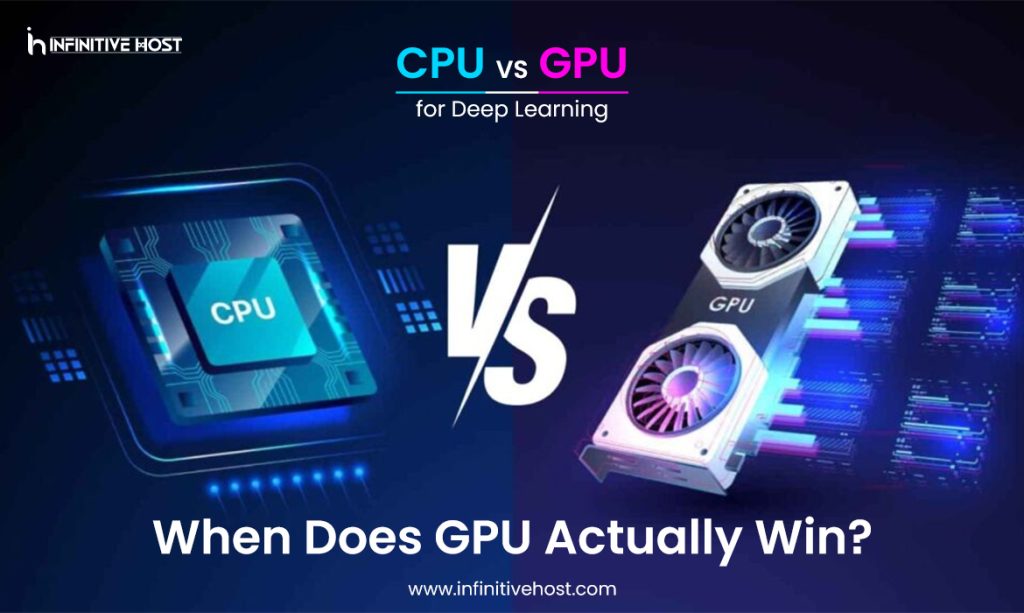
Ask any ML engineer whether a GPU server beats a CPU server for deep learning, and you’ll get an instant “obviously.” But that answer hides more than it reveals. CPUs still win in specific corners of the deep learning workflow — and knowing exactly where the line sits can save you real money on infrastructure you don’t need.
Let’s get specific.
The Key Difference: Parallelism, Not Only Speed
A CPU is a developer for sequential logic — a handful of robust cores running challenging instructions one after another, fast. A GPU server flips that design philosophy entirely: thousands of simpler cores executing the same operation across massive batches of data simultaneously.
Deep learning is, at its mathematical core, matrix multiplication at scale. Forward passes, backpropagation, gradient updates — nearly all of it reduces to tensor operations that parallelize beautifully. This is exactly the workload a GPU server was built for. A CPU executing the same matrix multiplication does it in a fraction of the parallel lanes, which is why training times on CPU-only infrastructure can stretch from hours into days or weeks for any non-trivial model.
That said, “GPU always wins” is a generalization that breaks down under real conditions.
When GPU Actually Wins

Training large neural networks. Anything beyond a small tabular model — CNNs, transformers, RNNs with meaningful depth — benefits enormously from a GPU server. The larger the model and dataset, the wider the performance gap. A task that takes 20 minutes on a modern GPU server can take 8+ hours on a high-end CPU server.
Batch processing at scale. When you’re training on millions of images or billions of tokens, batch parallelism is everything. A GPU server processes hundreds or thousands of samples per batch concurrently; a CPU server processes them in much smaller, slower batches regardless of core count.
Distributed training across nodes. Multi-node setups — like a Germany GPU server for distributed deep learning — use NVLink and InfiniBand interconnects to synchronize gradients across GPUs at speeds CPU clusters simply can’t replicate. This is where production-scale model training actually happens in 2026.
Real-time inference at volume. If you’re serving thousands of inference requests per second — recommendation engines, fraud detection, vision pipelines — a GPU server maintains low latency under load that a CPU server cannot sustain at the same throughput.
When CPU Still Holds Its Ground

It’s not a clean sweep, and pretending otherwise does readers a disservice.
Small models and classical ML. Logistic regression, decision trees, gradient-boosted trees (XGBoost, LightGBM) on modest tabular datasets often run just as fast — sometimes faster — on CPU. The overhead of moving data to GPU memory can outweigh the parallel compute gains for small jobs.
Low-volume or sporadic inference. If you’re running a handful of predictions per minute, a GPU server sits idle most of the time while still costing more than a CPU instance. Per-request cost matters more than raw throughput here.
Preprocessing and data pipelines. ETL, feature engineering, and data cleaning are still CPU-bound tasks. Don’t pay for GPU compute to do work that was never going to use the tensor cores anyway.
Budget-constrained experimentation. Early-stage prototyping, especially in cost-sensitive markets, sometimes makes more sense on CPU. This is the case where an India GPU cloud budget deep learning training server option becomes suitable—providing just sufficient GPU access to validate an idea before committing to a complete training run, without the overhead of exclusive dedicated GPU pricing.
Regional Infrastructure: Where You Train Matters
Deep learning infrastructure choices increasingly come down to geography, compliance, and cost — not just raw hardware specs.
In the UK, teams comparing UK GPU server versus CPU for model training consistently find that any model beyond a few million parameters justifies the GPU premium within the first few training runs, especially with London’s strong fibre connectivity reducing data transfer bottlenecks.
France has built out solid GPU infrastructure for research institutions, and a France dedicated GPU node for neural network training setup is common in academic and applied AI labs working on computer vision and NLP at scale.
For energy-conscious teams, Sweden GPU server energy-efficient deep learning deployments take advantage of the country’s renewable-heavy grid — training large models without the carbon cost typically associated with sustained GPU workloads.
Sensitive workloads — healthcare AI, financial modeling, biometric systems — often land in Switzerland. A Switzerland GPU server secure AI model training environment offers the jurisdictional protections these projects require, on hardware that doesn’t compromise on training speed.
Ireland GPU dedicated server for deep learning pipelines infrastructure has grown alongside the country’s broader data centre boom, offering strong transatlantic connectivity for teams serving both EU and US research teams.
In Northern Europe, a Netherlands GPU server scalable ML training cluster setup benefits from excellent interconnect bandwidth, making it a solid choice for teams that need to scale training horizontally across multiple GPU nodes without bottlenecking on data transfer.
And in the US, USA GPU dedicated server large-scale deep learning remains the dominant configuration for foundation model training, where compute budgets routinely run into the millions and every percentage point of GPU utilization matters.
Where Infinitive Host Fits In
Infinitive Host — also known in the community as InfinitiveHost — provides dedicated GPU infrastructure across all the regions above, purpose-built for deep learning workloads rather than general-purpose computing. Their nodes support multi-GPU configurations with NVLink, making distributed training genuinely viable rather than theoretically possible.
The current InfinitiveHost deep learning GPU — 25% OFF plans promotion makes this a good window to test whether a dedicated GPU server outperforms your current CPU-based setup on your actual workloads, rather than relying on generic comparisons. For teams that want hard numbers before switching, the GPU4Host deep learning GPU vs CPU benchmarks are a useful reference point — covering training time, throughput, and cost-per-epoch across common model architectures.
Conclusion
The honest answer to “GPU server vs CPU server” is: it depends on what you’re training, how often, and at what scale. For any meaningful deep learning workload — large models, big datasets, distributed training, high-volume inference — a GPU server wins decisively, often by an order of magnitude. For small models, sporadic inference, or classical ML on tabular data, a CPU server remains perfectly reasonable, sometimes even preferable on cost.