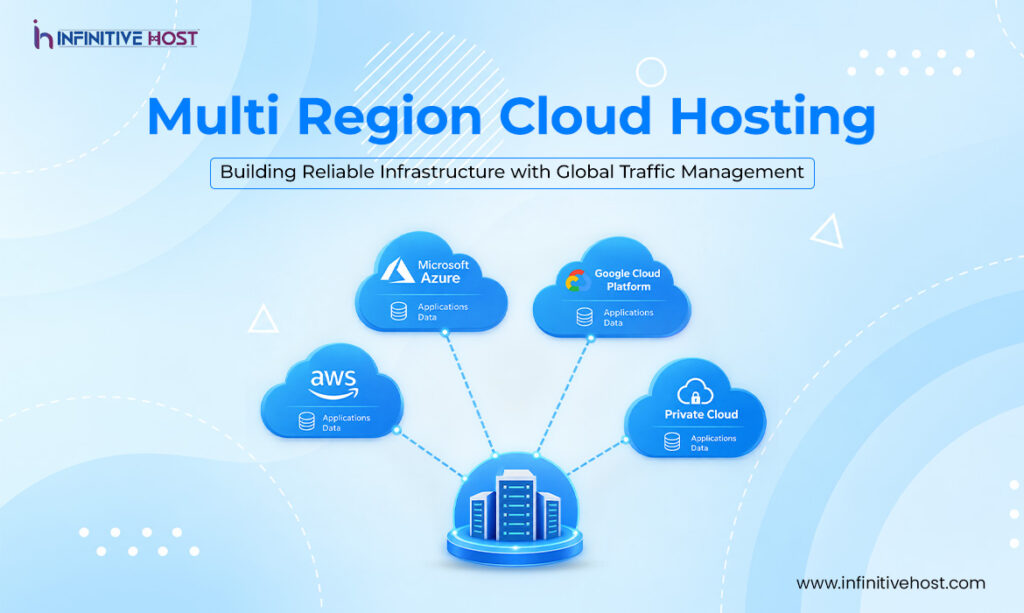
As most of the brands expand beyond their home markets, a single data center is sometimes enough to keep apps fast and available all the time. This is the case where multi region cloud hosting becomes more important. It allows all brands to run their apps across different geographic locations at a time, decreasing latency, improving uptime, and giving users a noteworthy experience no matter where they are logging in from. In this comprehensive guide, we will look at what multi region cloud hosting is, why global traffic management is important, and how most of the businesses can use these strategies to scale successfully.
What Is Multi Region Cloud Hosting?
Multi region Cloud Hosting involves hosting an application’s infrastructure across two or more different locations instead of solely relying on one primary location. Rather than routing every user request to a single server halfway across the world, the workload is allocated across a multi region cloud infrastructure, so almost all requests are served from the nearest or best-performing area.
This approach literally solves a lot of big problems that single-region hosting cannot. If any one of the locations experiences an outage, traffic can automatically move to a healthy region, keeping the application online 24/7. If user demand grows in a specific region, that region can easily manage the load independently instead of overwhelming a single server cluster. For any company that is fully serious about uptime and performance, multi region cloud hosting is no longer an option—it is becoming the key standard.
Why Global Traffic Management Matters
Multiple locations for the servers is one part of the equation; the other important element missing is the lack of an intelligent routing mechanism to guide the users to the appropriate location. Global Traffic Management is one such technique.
The way that the global traffic management works is through directing the request to the appropriate server location based on certain conditions including but not limited to location of the user, status of the server, and loads amongst others. Unlike the case where all users are sent to a fixed endpoint, traffic management technology uses methods like DNS routing, health checks, and load balancing to choose what to do in real time. In the process, a user in Singapore will be routed to the Asian server while the New Yorker will be connected to the US east coast data center server.
Proper international traffic management also becomes extremely important in case of failures. Should one particular area fail because of hardware malfunctions or other types of technical difficulties, the traffic will be redirected automatically within a matter of seconds. That is exactly what differentiates a pro system from an amateur hosting solution.
The Case for Multi Region Application Hosting
Multi-region application hosting provides several advantages for applications that have a growing number of end-users that are scattered across different geographic locations. One of the main issues here is latency; just a few hundreds of milliseconds of extra time can influence not only the quality of the service but also search engine rankings. Multi region cloud hosting decreases response time dramatically.
Then there is compliance to consider. Some sectors and nations need data to be stored or processed only within certain geographic borders. With multi-region application hosting, compliance can be achieved even when providing a cohesive experience for applications across all regions.
Scalability is one other advantage that comes with this technology. With increased traffic, the business needs to adopt cloud hosting for growing applications, which can grow without the need to revamp the entire infrastructure. The use of a multi-region architecture means that companies are able to provision capacity in certain regions depending on increased traffic demands.
Global Cloud Hosting for International Businesses
For companies whose clientele stretches across continents, global cloud hosting is no longer an option but a necessity. For those that provide software-as-a-service solutions, e-commerce websites or content-intensive sites, it is common to find users accessing their services from many countries around the world at various times during the day. One hosting platform simply cannot cater to all of them adequately.
This explains why more organizations opt for cloud hosting for global applications across several continents. Whether you are offering a media streaming service, an e-commerce website or a software solution as a service for business, the capability to deliver your service to nearby regions matters greatly.
Interestingly, this doesn’t always mean choosing one country over another. Many organizations combine regions strategically — using US cloud hosting for international users who need fast access to North American services, while also relying on cloud hosting in the USA for global applications that need to meet enterprise-grade compliance and performance standards. At the same time, businesses looking to serve emerging markets often explore Indian cloud infrastructure for global businesses, taking advantage of competitive pricing and growing data center capacity in the region.
Distributed Cloud Hosting and Deployment Strategy
Resilience in the construction of a system requires more than choosing different sites because the system should have a good deployment mechanism. Distributed cloud hosting usually entails duplicating applications, databases, and CDNs at chosen regions, then synchronizing them to ensure users get the same experience regardless of the servers they use.
The process of multi region deployment typically begins with determining the geographical location of the maximum number of users, and then picking those regions which provide the best possible combination of performance, cost, and compliance requirements. The next step would be to deploy global load balancing and monitor latency and errors in each region.
That is where the role of cross region cloud hosting becomes essential as well. The application layer is replicated, as well as database and storage, to ensure that the service cannot be brought down by the failure of any region at all.
Choosing the Right Hosting Partner
It is not all web host providers who can cater to this type of complexity. Companies require scalable cloud hosting solutions which come with built-in regional capabilities, fail-over support and traffic management tools without having to hire a DevOps team for the manual process of managing it all.
This is where the role of service providers such as Infinitive Host comes into play. With the provision of infrastructure that supports the hosting of servers in different regions, businesses are relieved of having to deal with complicated server management processes in order to develop their product.
Conclusion
In light of the increasing demand for applications to cater to an ever-increasing number of customers across the globe, single-hosting is no longer practical. With the help of multi region cloud hosting and proper traffic management, businesses will be able to ensure that they have everything necessary for their growth. Whether by means of distributed cloud hosting, smart multi region cloud hosting, or selecting the correct hosting service provider, getting your multi region cloud hosting sorted out today will save you from future downtime and loss of customers.