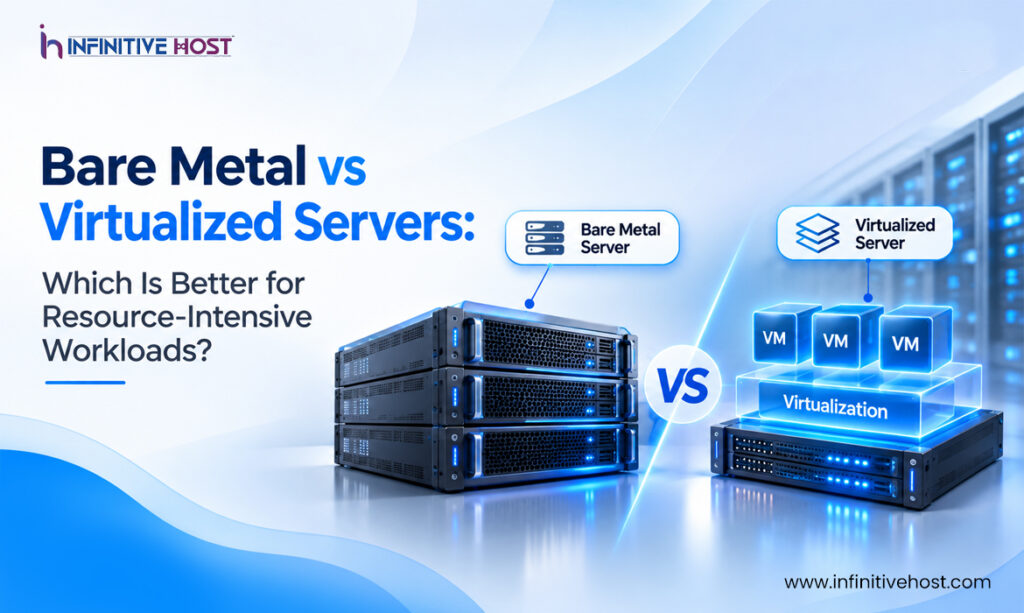
As workloads increase, businesses must select the right server infrastructure in order to ensure performance. AI programs, database work, video processing, high-performance computing, and enterprise applications require access to CPU, RAM, storage, and networking.
Nonetheless, being equipped with powerful hardware is not sufficient in itself for improving performance; the way in which the resources are accessed and allocated is equally important.
This highlights the importance of comparing bare metal and virtualized server infrastructure, both of which are capable of running resource-heavy applications but in different ways. While bare metal servers offer access to hardware resources, virtualized servers enable multiple virtual machines to use resources of one physical computer.
The best option depends on the amount of computational power that the application needs, the consistency of the resource consumption, and the desired degree of flexibility in terms of infrastructure.
Let us have a look at the differences and see which architecture would be better.
Understanding Bare Metal vs Virtualized Servers
Before comparing performance, it helps to understand how these two server environments work.
What Are Bare Metal Servers?
Bare metal servers are physical machines dedicated to a single client or application. These are different from virtualized servers because there is no need for a hypervisor layer between the OS and the physical hardware layer.
The operating system works on the server directly, giving the user access to all the available cores, memory space, storage devices, and network interfaces in the hardware machine.
For the enterprise user, this gives an advantage in terms of configuring the hardware according to specific application needs. The administrator will be able to customize the operating system, configure storage, and other parameters such as CPU affinity.
For instance, if an enterprise is working with a huge database, it can use bare-metal servers with high memory space, multiple NVMe SSDs, and high-performance CPUs to run the database continuously. Businesses that require exclusive hardware resources can explore dedicated server solutions designed for demanding workloads.
What Are Virtualized Servers?
Server virtualization involves using software known as a hypervisor to partition one physical server into several virtual machines (VMs).
Each VM runs its own operating system, with its own CPU allocation, memory, storage, and network configuration.
For instance, one can partition a physical server having 64 CPUs and 256 GB of RAM into several virtual machines. Each virtual machine gets its allocated resources.
This is because a hypervisor controls how virtual machines access the underlying physical hardware.
Through virtualized servers, organizations can run many applications on a single physical server without buying a new server for each application.
Virtualization of servers is used in applications such as hosting, development, testing, and business environments, where solutions like Linux Cloud VPS hosting provide flexibility in resource allocation.
Bare Metal vs Virtualized Servers: Key Differences
Although both architectures can provide substantial computing power, their approach to resource allocation, performance, and infrastructure management is different.
1. Hardware Resource Allocation
One of the key differences between bare metal vs virtualized servers is resource allocation in a physical server.
In bare metal infrastructure, the physical server is allocated exclusively to a single client. The CPU cores, RAM, disk, and networking resources can be utilized by this client only.
The advantage of this approach is better control over resource usage and decreased chances of interference caused by other clients using the same physical server.
In virtualized servers, the physical resources are divided between several virtual machines. The hypervisor manages scheduling of CPU cores, memory allocation, and access to hardware.
While such an approach increases the utilization of hardware, performance can vary greatly if there are too many clients on a physical server or resource allocation is done improperly.
Applications requiring constant high resource consumption will benefit from using dedicated hardware.
2. CPU Performance and Processing Power
CPU performance is important for applications that perform continuous calculations, analyze large amounts of data, or conduct multiple simultaneous operations.
Bare metal servers provide access to physical processor resources via the operating system. Configuration of the CPU affinity and other hardware parameters is possible as well.
Virtualized servers employ virtual CPUs, which are scheduled by the hypervisor to run on physical processor cores.
Processors and hypervisors today support hardware-assisted virtualization technology, which allows virtualized workloads to achieve performance levels that are very close to those of native hardware.
Nevertheless, the overcommitment of CPUs is the source of performance problems since competing virtual machines can experience scheduling delays and increased response times.
That’s the reason why the performance of bare metal and virtualized servers should be considered based on real CPU utilization and workload.
3. RAM Allocation and Memory Management
Memory management is particularly crucial for databases, analytics tools, AI applications, and other memory-intensive workloads.
Physical memory on the bare metal server can be used, which allows the administrator to set up memory channels and NUMA configuration based on the application needs.
A virtualized server assigns memory to VMs using a hypervisor.
It gives flexibility, but memory over-provisioning, ballooning, swapping, and misconfigured NUMA may affect application performance in some cases. Understanding how memory pressure affects applications is also important when evaluating server capacity, particularly when a server runs out of RAM.
So for applications that use large amounts of data stored in memory regularly, these points have to be considered.
Thus, when comparing bare metal vs virtualized servers, it is not only about how much memory is available. Memory bandwidth, latency, and its assignment play a role too.
4. Storage Performance and I/O Operations
Storage performance impacts applications that need frequent reading and writing of information.
Enterprise databases, transaction processing, and analytics applications rely on storage latency, IOPS, and bandwidth.
Bare metal servers allow direct access to the dedicated NVMe SSD storage and storage controller.
Administrators can configure storage to meet the needs of specific applications.
Virtual servers have virtual disks communicating with storage through the hypervisor and host storage stack.
Virtualization systems utilize storage drivers to minimize extra overhead, but shared storage and concurrent I/O operations can impact performance anyway.
In the case of intensive database usage, benchmarking actual storage performance is more helpful than simply comparing storage capacity figures. Similar considerations apply to streaming server storage requirements, where disk speed, capacity, and read/write performance affect media delivery.
5. Network Performance and Latency
Network performance is important in scenarios where applications transfer huge amounts of data or communicate with many systems.
Bare-metal infrastructure allows for having physical network interfaces as well as increased control of the network setup.
Virtualized servers tend to have virtual network interfaces controlled by the networking layer of the hypervisor.
Features like SR-IOV and network passthrough can give a higher level of physical network accessibility and lower the overhead from virtualization.
Yet, shared network bandwidth and virtual switch setups can impact performance.
Businesses with streaming platforms, distributed databases, and other applications should consider the network throughput and latency when choosing infrastructure.
Which Architecture Is Better for Resource-Intensive Workloads?
But there isn’t a simple answer, as different applications consume computing resources differently.
The right infrastructure will depend on whether the application requires consistent processing power, bandwidth for memory, storage speed, exclusive access to the graphics processing unit, or dynamic resource usage.
Here are some examples.
AI and Machine Learning Applications
Computing power and memory required for the use of AI and machine learning can be quite high, especially when training the model.
Performance of the GPU, VRAM capacity, bandwidth, and interaction between CPU and GPU affect processing speed. These factors should also be considered when evaluating AI server hardware requirements for inference workloads.
The use of bare metal servers can be beneficial for AI-related tasks, which require exclusive GPU usage, particular hardware configuration, and control over PCIe connectivity. Businesses exploring dedicated GPU infrastructure for these workloads can also consider GPU server solutions for AI and machine learning.
Nevertheless, virtual machines can be used for intensive AI applications through GPU passthrough or via virtual GPU technology.
In the case of GPU passthrough, the physical GPU will be allocated to the virtual machine, providing almost no extra overhead.
When considering bare metal vs. virtualized servers for AI applications, the organization needs to analyze GPU access, VRAM needs, interconnect bandwidth, and data transfer speed.
High-Performance Computing
High-performance computing (HPC) requires complicated computations that may span more than one processing core or node.
Tasks like scientific simulations, engineering applications, finance modeling, and research projects may have a need for high processing speed and inter-system communications.
This is an instance where bare metal servers can come in handy because they offer a higher level of control over CPU layout, memory architecture, and network performance, especially when configured for GPU-intensive computing workloads.
Some HPC workloads may run in virtualized settings provided they are properly set up. Some workloads may require specialized hardware or have strict latency constraints.
Large Databases and Analytics
In many cases, the work involved in using databases involves the execution of queries, transactions, indexing, and background processes.
All of these activities put significant stress on the CPU, RAM, and storage.
Physical servers are well suited to databases requiring consistent I/O performance, high memory capacity, and guaranteed resource availability.
Virtual servers can be an efficient solution for companies that have several distinct database installations or applications with fluctuating resource needs.
When choosing server resources for databases, transaction numbers, storage latency, memory, and CPU competition are factors to consider.
Video Streaming and Media Processing
Continuous media streaming requires that video streaming websites manage constant media streaming, media encoding, media transcoding, and lots of concurrent connections.
Bare-metal servers can be used in continuous media processing where dedicated CPU/GPU processing capabilities and network capabilities are required, particularly for streaming server transcoding and real-time media conversion.
Virtualized servers are helpful in distributed media streaming where application scaling and flexible deployment are required.
The choice of architectural type depends on the major requirement that may either be encoding, network, storage, or scalability.
When Should You Choose Bare Metal Servers?
Bare metal infrastructure should be considered where there is a need for reliable access to dedicated physical hardware.
It is especially valuable under the following circumstances:
Your application constantly uses resources: High CPU, RAM, or storage consumption can make use of dedicated hardware.
Performance consistency is important: Programs that have stringent response time requirements can take advantage of lower resource contention.
Hardware customization is required: Certain CPU configurations, GPU hardware, storage controllers, and network configuration might require more hardware control.
You work with big data: Data-hungry applications can make use of dedicated storage and memory configuration.
You have specialized infrastructure requirements: Certain enterprise applications and computational frameworks require special hardware configuration or direct access to hardware.
In all these cases, bare metal infrastructure provides the user with a dedicated infrastructure setup.
When Are Virtualized Servers the Better Choice?
Virtualization is not something that only happens with small applications and basic hosting needs. If correctly configured, virtual machines can handle many different business workloads.
Virtualized servers prove especially helpful when businesses need:
Resource flexibility: CPU, memory, and storage allocation for each application will vary.
Various environments: Applications for development, testing, staging, and production will be able to function independently in the same infrastructure.
Rapid provisioning: Virtual machines can be created without buying and installing any physical hardware.
Hardware efficiency: Various applications will be able to use physical resources at once.
Infrastructure ease: Snapshots, cloning, and migration, among other functions, make virtualized environments easier to manage.
As workloads change, virtualization provides greater flexibility. without the need for having a separate physical server for each application.
Bare Metal vs Virtualized Servers: Can a Hybrid Approach Work?
Businesses don’t necessarily have to go for one architectural form across their entire infrastructure.
Hybrid infrastructure is an infrastructure that uses both physical dedicated servers and virtualized systems depending on the workload.
For instance, a business can use dedicated physical servers for running its database system and GPU-intensive systems and virtualize everything else.
In this way, businesses will be able to allocate their physical resources to critical applications and still benefit from flexibility in using virtualization technologies in other applications.
Hybrid infrastructures can simplify migration processes in organizations.
Rather than migrating all applications, resource-heavy applications can be migrated at a time.
A hybrid infrastructure is ideal for organizations that require both predictability and efficiency in their infrastructures.
How to Choose the Right Server Architecture
Prior to making a choice about bare-metal vs. virtualized servers, companies need to examine how their applications consume computing resources.
To begin with, it is necessary to understand the main workload requirements. Applications that are heavily dependent on CPU processing might require a different setup from those demanding high memory throughput or fast storage processing.
The next step is to pay attention to how resource consumption is changing during high traffic times.
This will reveal whether there are any issues with CPU scheduling, memory exhaustion, storage bottlenecking, or networking.
Tests using sysbench, fio, and iperf3 tools may help to determine the performance of CPU, storage, and network, respectively.
Finally, companies need to compare the overall costs of infrastructure setup, instead of paying attention only to the monthly price of a server.
Final Thoughts
The choice of bare metal or virtualized servers is all about understanding the needs of your applications.
While bare metal servers have several advantages, including dedicated resources and better hardware management, as well as reliable resource availability, virtualized servers are known for resource flexibility, faster deployment, and high efficiency in physical hardware use.
Businesses facing resource-heavy tasks need to analyze such aspects as CPU performance, memory bandwidth, storage I/O, network latency, and hardware requirements of particular applications before choosing the type of infrastructure.
The perfect infrastructure is not always the one with the most available resources. Occasionally, it is simply the one that provides necessary performance, scalability, and optimal use of computing power.
InfinitiveHost offers server infrastructure to companies that want to ensure the reliability of computing resources for their applications. Proper configuration of infrastructure according to the needs of applications can be a solid basis for company development.