Most people pick their GPU hosting the same way they pick a hotel — cheapest available option that looks decent enough. Then they wonder why their model training takes twice as long as expected or why inference latency spikes at the worst possible moments.
The choice between a Bare Metal GPU Server vs Virtual GPU Server isn’t a minor technical detail. It’s the decision that determines whether your AI infrastructure holds up under real production pressure or quietly becomes your biggest bottleneck.
What You’re Actually Comparing
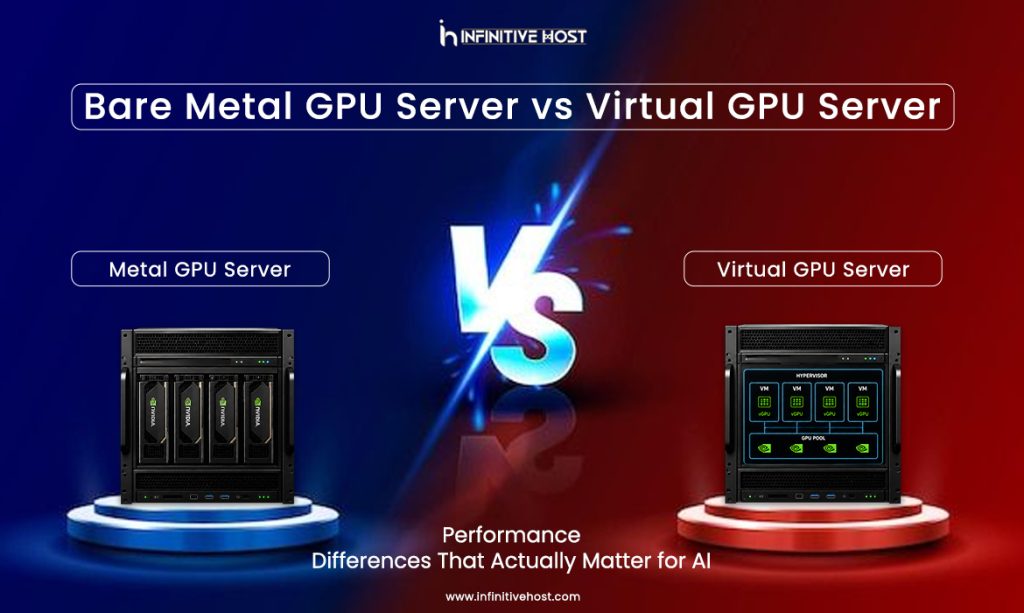
A bare metal GPU server gives you direct, unshared access to physical hardware. No hypervisor layer. No virtual machine overhead. No other tenants share the same silicon. When you send a workload to the GPU, it goes there — nothing in between.
A virtual GPU server slices physical hardware across multiple tenants using virtualization. It’s flexible and often cheaper to start with, but every layer of abstraction between your workload and the hardware costs something — usually latency, throughput, or both.
For casual workloads, that gap is manageable. For serious AI, it isn’t.
Where the Performance Gap Actually Shows Up

Memory bandwidth is the first place you feel it. Large language models, diffusion models, and transformer architectures move enormous amounts of data between GPU memory and compute cores. On a Bare Metal GPU Server vs Virtual GPU Server, the bare metal option delivers full memory bandwidth — no sharing, no throttling. Virtual environments impose overhead that compounds as model size grows.
I/O consistency matters just as much. Training pipelines read from storage, process batches, write checkpoints, and repeat thousands of times. On virtualized infrastructure, I/O operations compete with other tenants invisibly. On bare metal, your pipeline gets what the hardware can actually deliver — every single time.
Driver-level access is something most people don’t think about until they need it. Bare metal lets you run custom CUDA kernels, specific driver versions, and low-level optimizations that hypervisors simply block. If you’re doing anything beyond standard inference, this matters.
Global Bare Metal GPU Hosting: Region by Region

Where your server lives shapes more than just latency. Compliance, cost, and connectivity all vary significantly by region.
United States: Companies requiring GPU compute power from data centers always ensure that their training data and model weights reside within the United States jurisdiction—relevant to government contracting, health-care AI, and financial service providers.
United Kingdom: Brands developing generative AI products want high-bandwidth GPU servers in the UK for generative AI — mainly post-Brexit, where UK data management needs differ from the EU framework.
Sweden: Environmental accountability is progressively a procurement need. AI GPU hosting with carbon-neutral operations in Sweden allow organizations to achieve their sustainability goals without sacrificing computing power.
Switzerland: Regulated industries — banking, pharma, insurance — need enterprise AI GPU hosting with Swiss-level data protection, where both legal framework and physical security standards are among the tightest in the world.
France: Paris-based GPU bare metal infrastructure sits at the core of Europe’s connectivity backbone, which makes it the best option for latency-sensitive deployments serving Western European users.
Netherlands: For European deployments that need hardware isolation without the Swiss price premium, the option to rent a dedicated GPU server in the Netherlands offers single-tenant performance at competitive rates.
Ireland: EU-based companies building compliant AI pipelines can rent a bare metal GPU server in Dublin and stay within GDPR boundaries while accessing some of the best-connected data center infrastructure in Western Europe.
Germany: Industrial AI, automotive machine learning, and enterprise automation workloads all benefit from German data center GPU bare metal for AI workloads — built to engineering standards that match the applications running on them.
India: The SaaS and AI startup ecosystem across South Asia has a growing need for low-latency GPU cloud for Indian SaaS and AI companies — keeping inference close to end-users rather than routing through distant European or American data centers.
Choosing the Right Provider
When you’re comparing reliable GPU server hosting vendors, the hardware spec sheet is only part of the story. Look at network redundancy, support SLA, hardware generation availability, and whether the provider can actually deliver bare metal at the region you need.
Infinitive Host covers all of it. With bare metal GPU deployments across the regions above, hardware ranging from entry-level inference nodes to multi-GPU H100 clusters, and straightforward pricing, Infinitive Host has become a serious option for businesses that have outgrown virtual GPU tiers. Right now, Infinitive Host is offering GPU bare metal at 25% discount — act before it expires — making this one of the better moments to move from virtual to dedicated infrastructure if you’ve been sitting on the decision.
The Bare Metal GPU Server vs Virtual GPU Server question gets a lot clearer when the cost gap narrows. At 25% off, bare metal becomes the obvious choice for anyone running production AI workloads.
Conclusion
The Bare Metal GPU Server vs Virtual GPU Server debate has a straightforward answer for production AI: bare metal wins on performance, consistency, and long-term cost at scale. Virtual GPUs have their place in development and testing — but when your model needs to perform reliably, shared infrastructure is the wrong foundation. With global options from providers like Infinitive Host, and current discounts making the switch more accessible, there’s no good reason to stay on virtualized hardware longer than you need to.
Read Related – how to choose the right gpu dedicated server for ai 2026