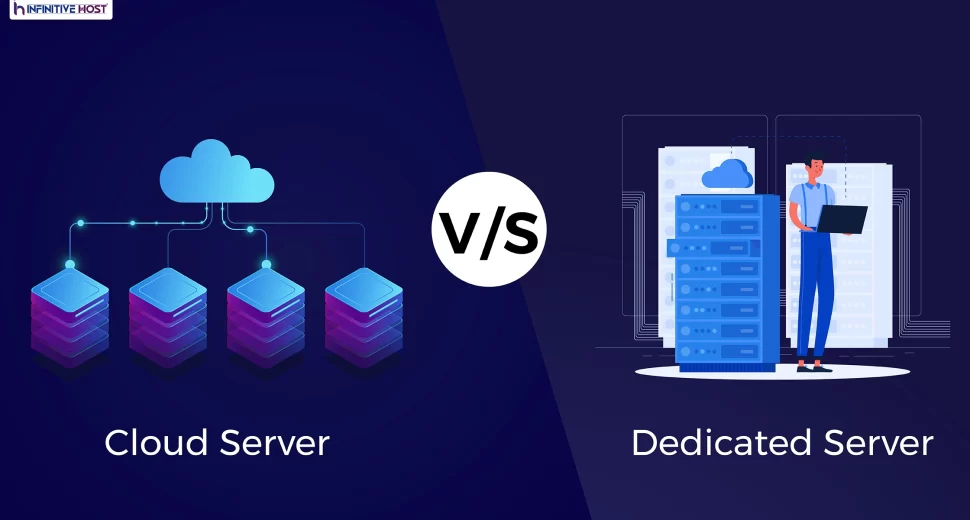
Cloud Server vs Dedicated Server: Comparing the Differences
When brands plan their IT infrastructure, one of the most important decisions they generally face is selecting between a cloud server vs dedicated server. Both available solutions have unique benefits, and the right choice depends entirely on your tasks, budget, performance needs, and long-term scalability goals. In this complete blog, we will just break down everything you wish to know about—ranging from powerful architecture and pricing to modern security and real-world use cases—so you can always make a confident, well-versed decision.
What Is a Cloud Server?
A cloud server refers to a virtual server that simply runs on a shared pool of physical hardware handled by a reliable cloud provider. Different assets, such as RAM, CPU, and storage, are allocated dynamically, which states that you can easily scale up or scale down as per real-time demand.
Scalable cloud hosting is one of the main draws of this model. Even if you are a startup thinking about unexpected traffic growth or an enterprise handling varying tasks, cloud servers can accommodate instant changes without the need for hardware procurement. The most reliable service providers are Google Cloud, AWS (Amazon Web Services), and Microsoft Azure, all of which provide a pay-as-you-go pricing model that keeps prices highly predictable for changing tasks.
Core characteristics of cloud servers are:
- Virtualized infrastructure, along with shared physical hardware
- Quick scalability on demand
- Pay-as-you-go pricing models
- High availability with the help of multi-node redundancy
- Geographic allocation across data centers
What Is a Dedicated Server?
A dedicated server is a kind of physical machine exclusively allocated to a single client at a time. There is no sharing of hardware assets—every single CPU core, gigabyte of RAM, and storage unit belongs completely to your business.
A high-performance dedicated server is the most trusted solution for all those brands that need raw computing power, consistent latency, and complete access to their web hosting environment. Apart from cloud environments, dedicated servers are not related to the “noisy neighbor” effect—a scenario where all other users on shared infrastructure use the wrong resources and reduce performance.
Brands in India have increasingly turned to dedicated server India solutions to reduce latency for all local-level users, adhere to the data residency guidelines, and support scaling digital infrastructure requirements. Even if you are in an industry like fintech, e-commerce, or media streaming, a dedicated server situated in an Indian data center can drastically enhance end-user experience.
Cloud Server vs Dedicated Server: A Head-to-Head Comparison
1. Performance
In the case of raw performance, dedicated servers have a proper advantage. An enterprise dedicated server well-fortified with high-core-count processors and NVMe SSDs offers constant, predictable performance without asset contention.
Cloud servers, which are proficient in enhanced performance, are related to hardware sharing. For CPU-heavy workloads—like video rendering, real-time data processing, or high-traffic databases—a dedicated server is generally the powerful solution.
Winner: Dedicated Server for constant, latency-heavy tasks.
2. Scalability
Scalable cloud hosting stands out here. Cloud servers help brands to provision extra resources within minutes, which makes them a perfect option for seasonal traffic growth, product launches, or inconsistent growth patterns.
Dedicated servers need physical upgrades—ordering demanding hardware, shipping, installation, and setup—which can take a lot of days or even some weeks. However, most of the modern dedicated server solution providers provide quick deployment options to decrease this lead time.
Winner: Cloud Server, especially for on-demand, smooth scalability.
3. Security
Both of the server environments can be made highly protected, but they take multiple approaches.
A secure dedicated server hosting setup gives businesses full access to their safety pattern. There is no multi-tenancy issue, stating that no other company’s vulnerabilities can bleed into your chosen infrastructure. You control firewall guidelines, OS-based hardening, encryption rules, and physical access strategies.
Cloud servers depend completely on the service provider’s shared security model. While the key providers invest mainly in compliance and certifications, the shared environment of the infrastructure introduces extra risk vectors — especially for businesses managing important financial, health, or government-related data.
Winner: Dedicated Server for all those environments that need robust data isolation and compliance.
4. Cost Structure
Cloud servers run on a subscription or usage-based model—you have to pay only for what you use in real life. This is a budget-friendly option for small businesses or those with scaling needs.
Dedicated server plans generally consist of higher upfront or monthly fixed prices, but those costs are completely predictable. For brands running constant, high-utilization tasks, dedicated hosting now becomes more affordable with time as compared to equivalent cloud assets at scale.
Winner: Relies on utilization pattern—cloud for scaling loads, dedicated for steady-state high usage.
5. Management & Control
Here, the difference between managed dedicated server and unmanaged dedicated server hosting becomes crucial.
With the help of a managed dedicated server, a trustworthy hosting provider, like Infinitive Host, manages all OS updates, safety patches, constant server monitoring, and technical support. This is a perfect option for brands without a dedicated in-house IT expert. Whereas an unmanaged dedicated server hands complete access to the client—ideal for all those who are highly experienced system admins and wish for full customization.
Cloud servers are also available in both unmanaged and managed versions, but the OS-level access can be more limited, relying on the service provider and chosen solution.
Winner: Dedicated Server for full control; Cloud for the comfort of management.
Choosing the Right Dedicated Hosting Provider
If you think that a dedicated server is an ideal match, then choosing the right dedicated hosting provider is paramount. Here are some of the essential factors that need to be considered:
- Data center location: For Indian brands, proximity is really important. A dedicated server India provider, along with local data centers, guarantees reduced latency and legal compliance simply with all India’s data security guidelines.
- Hardware specifications: Identify RAM setups, processor generations, SSD vs HDD storage, and network bandwidth solutions.
- Uptime Guarantee: Opt for those providers that offer 99.9% or more than that uptime.
- Support quality: Getting expert support with instant response times is mostly non-negotiable for production-level tasks.
- Scalability of dedicated server plans: The service provider should deliver tiered solutions so you can choose the right-sized investment as your business scales.
When to Go for Cloud Hosting
Cloud hosting is a perfect choice for:
- Startups and SMEs with restricted budgets
- Apps with inconsistent or highly fluctuating traffic
- Development and testing environments
- Multi-location global deployments
- Brands giving priority to deployment speed over raw performance
When to Choose a Dedicated Server
Dedicated servers are appropriate for:
- High-traffic e-commerce platforms and marketplaces
- Financial apps demanding reduced latency and data isolation
- Advanced gaming servers and modern apps
- Huge databases with constant I/O requirements
- Enterprises under regulatory compliance (such as PCI-DSS, HIPAA, ISO 27001)
- Brands looking for an enterprise dedicated server infrastructure for mission-based processes
Can You Use Both? The Hybrid Approach
Most of today’s brands are looking for a hybrid model, utilizing scalable cloud hosting for advanced development, staging, or high traffic while depending on dedicated servers for key production tasks. This approach pairs both the scalability of the cloud with the performance and safety of dedicated infrastructure.
For scaling Indian brands, this hybrid method is increasingly well-liked: a dedicated server India for key processes keeps data local and optimized, while cloud assets manage burst capacity or worldwide-level deployments.
Conclusion: Cloud Server vs Dedicated Server
There is no fixed answer in the debate of cloud server vs dedicated server. The decision completely depends on your business needs:
- Go for cloud hosting if reliability, scalability, and low initial cost are your priorities.
- Select a dedicated server if performance, safety, compliance, and complete access are non-negotiable.
For brands that wish for trustworthy dedicated server solutions, mainly all those running in India or offering high-traffic, data-based apps, investing heavily in a dedicated hosting provider with powerful infrastructure is the best decision that pays dividends in demanded uptime, unbeatable performance, and peace of mind.





One Response