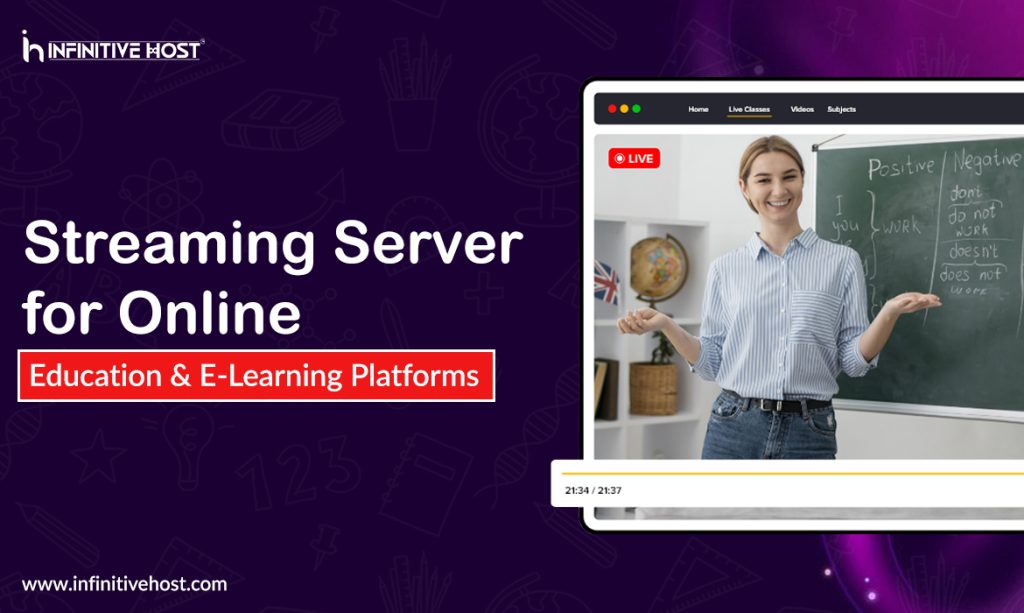
Online education has a dirty secret: the course content rarely kills the platform. The streaming infrastructure does.
Students don’t leave because your curriculum is weak. They leave because the video buffered at the wrong moment, the live class dropped mid-session, or the playback quality tanked the second three classrooms went live simultaneously. In e-learning, the streaming server isn’t a backend detail — it’s the product.
If you’re running an online education platform in 2026 and you’re still treating video hosting as an afterthought, this is the article that changes that.
Why Generic Hosting Kills E-Learning Platforms
Most platforms start on shared hosting or consumer-grade CDNs. It works fine at 50 students. It starts cracking at 500. By 5,000 — especially during peak enrollment periods or live exam sessions — it collapses in ways that are very hard to walk back from with your user base.
A streaming server built specifically for education handles two things that generic infrastructure doesn’t: simultaneous live sessions and deep VOD libraries running in parallel. When your morning cohort is doing a live Q&A while your evening cohort is rewatching recorded lectures and your weekend learners are downloading course materials — all of that runs through the same infrastructure. It either holds or it doesn’t.
The difference between a streaming server optimized for this and a repurposed web server trying to do the same job is measurable in buffering seconds — and buffering seconds are measurable in churn rate.
Live Streaming vs VOD: You Need Both, Handled Differently
One mistake e-learning platforms make is treating live streaming and VOD as the same technical problem. They aren’t.
Live streaming demands low latency above everything. A 10-second delay in a live coding class or a language lesson with real-time conversation isn’t just annoying — it breaks the format entirely. Your streaming server needs to be geographically close to your learners, with enough headroom to absorb traffic spikes when a class starts and 300 students connect within 90 seconds.
VOD hosting is a different beast. It’s about storage efficiency, adaptive bitrate delivery, and consistent playback across devices and connection speeds. A student in a rural area rewatching a lecture on 4G needs the same reliable experience as someone on fibre in a major city.
The best setup is live streaming and VOD hosting built for online courses on the same infrastructure — not stitched together from separate tools that create handoff problems and billing complexity.
Location Is Not a Minor Detail
Where your streaming server sits physically determines the quality of experience for your learners. This is non-negotiable for platforms with geographically concentrated user bases.
A New York streaming server for US university programs, bootcamps, and professional certification platforms serving the East Coast and Midwest. Lower latency to major population centres, and proximity to academic institutions that increasingly run hybrid online-offline programs.
For platforms serving British schools, colleges, and corporate training programs, a London streaming server for UK e-learning platforms puts your infrastructure inside the same jurisdiction as your users — which also helps with UK GDPR compliance for platforms handling student data post-Brexit.
Los Angeles streaming server for creator-led online courses — the kind built by YouTube educators, coaches, and independent instructors who grew their audience on the West Coast and are now monetising through their own platform rather than a third-party marketplace.
Canada’s e-learning market is larger than most people realise, and its bilingual requirements make infrastructure decisions genuinely complex. A Montreal streaming server for bilingual Canadian education platforms requires a latency profile to serve both French and English learners reliably, without routing traffic across borders unnecessarily.
The point isn’t just speed. It’s that a dedicated streaming server close to your users reduces the number of hops your video packets take — and every hop is an opportunity for quality degradation.
What to Actually Look for in a Streaming Server
When evaluating a dedicated streaming server for your learning platform, cut through the spec-sheet marketing and ask these questions:
Can it handle concurrent live sessions? Not one. Many. Simultaneously. With different instructors, different class sizes, and different stream qualities.
Does it support adaptive bitrate streaming? Your learners don’t all have the same connection. Adaptive bitrate adjusts quality in real time rather than buffering or failing.
What’s the storage and bandwidth model for VOD? Unlimited promises have limits buried in fair-use clauses. Know exactly what you’re getting for your course library as it grows.
Is there a content delivery network built in? A streaming server without CDN integration forces your video to travel the full distance from origin to viewer — which defeats the purpose of location-optimised hosting.
What happens during a traffic spike? Your platform’s biggest moment — a product launch, a viral moment, an exam period — is also its highest-risk moment. Your infrastructure needs a credible answer for what happens then.
Providers like Infinitive Host have built streaming infrastructure specifically around these questions. Their dedicated streaming server configurations are designed for platforms that have outgrown consumer video hosting but aren’t ready to build custom media infrastructure from scratch — which covers most serious e-learning businesses.
The Cost Conversation Nobody Wants to Have
Dedicated streaming infrastructure costs more than shared hosting. That’s true. It also costs less than the customer support overhead of a platform that drops streams, less than the churn from students who don’t renew, and far less than the reputation damage of a live class failing during peak enrollment.
The ROI calculation on a proper streaming server isn’t hard to make when you frame it correctly. It’s not “infrastructure cost vs zero.” It’s “infrastructure cost vs the business cost of infrastructure failure.”
Claim 25% off streaming platform from Infinitive Host for new customers — which makes this a reasonable moment to run those numbers seriously if you’ve been putting off the upgrade.
Conclusion
The e-learning market is crowded. Every platform promises great content and expert instructors. What separates the ones that retain students from the ones that don’t is usually invisible — until it breaks.
A reliable streaming server is the kind of infrastructure that nobody notices when it’s working and everyone notices when it isn’t. Build on the right foundation now — geographically close to your learners, purpose-built for live and VOD education workloads — and your platform earns the trust that turns one-time students into long-term customers.
That’s not a hosting decision. That’s a growth decision.