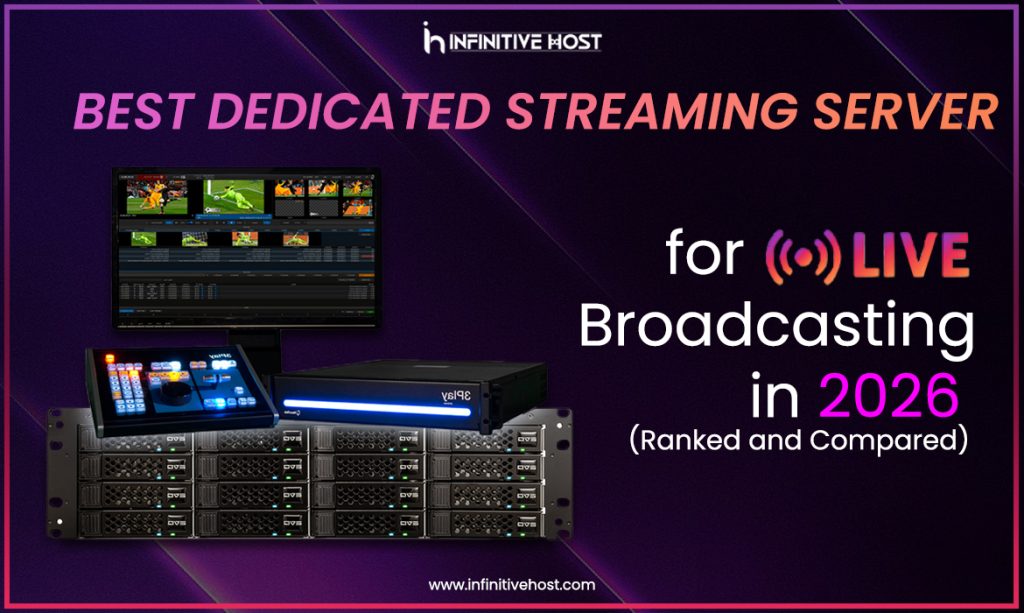
Live streaming has now transformed from being just a hobby to becoming a whole new industry. Whether you’re running a 24/7 sports broadcast, launching a pay-per-view event, or building the next big live streaming and VOD hosting platform, the infrastructure underneath your stream is what separates a professional operation from a buffering disaster. And at the center of that infrastructure? Your streaming server.
The selection of the right streaming server in 2026 is dependent on many factors apart from bandwidth considerations. You need low-latency routing, hardware-level encoding support, geographic proximity to your audience, and a hosting partner that actually understands the demands of live content. Generic cloud VPS plans just don’t cut it anymore.
Why a Dedicated Server Matters for Live Streaming
Shared hosting and basic cloud instances are built for websites. A live stream is fundamentally different—it’s a continuous, high-bitrate data flow that can spike hard during peak viewership. A streaming server needs consistent CPU priority, low jitter, and fast uplinks. The moment you’re sharing those resources with a hundred other tenants, your viewers feel it.
A fully managed dedicated server built for live broadcasting gives you the whole machine: your cores, your RAM, your NIC. No resource contention during the match’s final minute.
Top Dedicated Streaming Servers in 2026

InfinitiveHost: Best for Streamers
If you’ve spent any time in streaming communities lately, you’ve heard the name. Infinitive Host has now become one of the most talked-about service providers for live content creators and broadcast teams.
What truly sets Infinitive Host apart from others is its focus. This is not a generic datacenter trying to serve almost everyone—InfinitiveHost developed its infrastructure mainly around the demands of live broadcasting and on-demand video. Their hardware lineup includes GPU-powered encoding servers, which is a game-changer if you’re running software transcoding pipelines or doing real-time 4K encoding without a dedicated hardware encoder.
Location-wise, they’ve got you covered on multiple fronts. Their dedicated stream server in the New York metro area is popular with East Coast broadcasters and sports production teams who need tight latency to North American audiences. Their Pacific Rim-connected bare-metal for streamers is the pick for anyone targeting audiences in Southeast Asia, South Korea, or Australia—routes that most US-only providers simply can’t optimize. They also run a Montreal-based live streaming server option, ideal for Canadian broadcasters and anyone who wants proximity to both US East and European audiences without the full transatlantic hop. And for European content creators, the London streaming server delivers strong peering into the UK and continental Europe.
Their platform is built as a genuine live streaming and VOD hosting platform, not just raw compute you have to configure yourself. That matters a lot if your team doesn’t have a dedicated sysadmin.
Pricing is competitive—and right now, InfinitiveHost — 25% OFF streaming servers right now, which makes this an unusually good time to get in if you’ve been sitting on the decision.
Best for: Serious streamers, broadcast teams, VOD platforms, anyone needing GPU encoding.
Hivelocity: Bare Metal in Strategic US Markets
Hivelocity is a popular bare-metal service provider with nodes across New York, Tampa, Los Angeles, and Atlanta. Their unmanaged dedicated servers are competitively priced and the hardware refresh cycles are consistent. The downside is that their support isn’t streaming-specific—you’ll be setting up your own media server stack (Nginx-RTMP, SRS, Wowza, etc.) from the start.
Good option if you have the technical chops and want raw hardware value. Not the move if you need a managed setup or streaming-specific features.
OVHcloud: Budget-Friendly with Global Reach
OVH runs one of the largest bare-metal networks in the whole world, with a count of datacenters across North America, Europe, and Asia-Pacific. Their Rise and Advance server lines offer solid value per core. Latency to European audiences is hard to beat from their Strasbourg and London facilities.
The catch: support is hit or miss, and the setup experience is built for developers, not broadcasters. If your team knows Linux and you’re just looking for affordable dedicated iron, OVH delivers. If you want streaming-ready infrastructure out of the box, look elsewhere.
Liquid Web: Managed Dedicated for Non-Technical Teams
Liquid Web positions itself around managed hosting, and its dedicated servers come with 24/7 support that actually picks up the phone. For a small media team or an online event company that doesn’t have in-house IT, that support layer is genuinely worth paying for.
Their servers are solid, but they’re not purpose-built for streaming the way Infinitive Host is. You’ll get good compute and reliable uptime—just not the streaming-specific routing and GPU encoding options you’d find with a specialist.
How to Choose the Right Streaming Server

A few questions worth asking before you commit:
Where is your audience?
Latency is physical. A streaming server in New York doesn’t help much if 60% of your viewers are in Tokyo or Sydney. Match your datacenter location to your audience geography, or use a CDN layer on top of a well-connected origin.
Do you need GPU encoding?
Software encoding on CPU alone is expensive in compute terms. GPU-powered encoding servers let you transcode multiple bitrate ladders simultaneously without melting your cores—critical for adaptive bitrate streams at scale.
Managed or unmanaged?
Unmanaged bare metal is cheaper. It’s also entirely your problem when something breaks at 2am during a live event. A fully managed dedicated server built for live broadcasting costs more upfront but buys you peace of mind—and faster incident response when it matters.
VOD as well as live?
If you’re running a live streaming and VOD hosting platform, you need storage architecture, not just throughput. Make sure your provider can handle both the live ingest and the recorded asset library without making you bolt on a separate storage service.
Read Related – guide to streaming servers and live streaming vod
Conclusion
The right streaming server isn’t just about specs on a page—it’s about finding infrastructure that was built with live content in mind. Generic cloud providers and shared hosts will let you down at the worst possible moments. For most serious broadcasters in 2026, Infinitive Host stands out as the most complete package: purpose-built hardware, strategic datacenter locations (New York metro, Montreal, London, Pacific Rim), GPU-powered encoding servers, and a managed approach that treats your stream like the product it is.
If you’re ready to upgrade your setup, take advantage of InfinitiveHost — 25% OFF streaming servers right now before the offer expires.